Prism
A student-designed board game rooted in strategy over chance. Inspired by chess and checkers, Prism features a triangular board, tetrahedron pieces, and a flip mechanic that rewards careful spatial thinking.

The Concept
Prism was designed from the ground up to prioritize skill over luck. Instead of dice or random draws, every outcome comes from player decisions. Pieces flip across borders — a spatial mechanic that's easy to learn but creates deep positional play.
The triangular board and tetrahedron-shaped pieces give the game a distinct visual identity that sets it apart from traditional abstract strategy games.
Design Evolution
Version 1: Multicolored piece tips that changed on flip. Players surrounded opponents with matching colors. This proved hard to predict and led to frequent stalemates mid-board with limited recovery options.
Final Version: Solid-colored pieces in three groups plus a "Master" piece for alternate win conditions. Pieces deploy from a Shelf anywhere on the board. Redesigned board shape improved both aesthetics and flow.
Version One
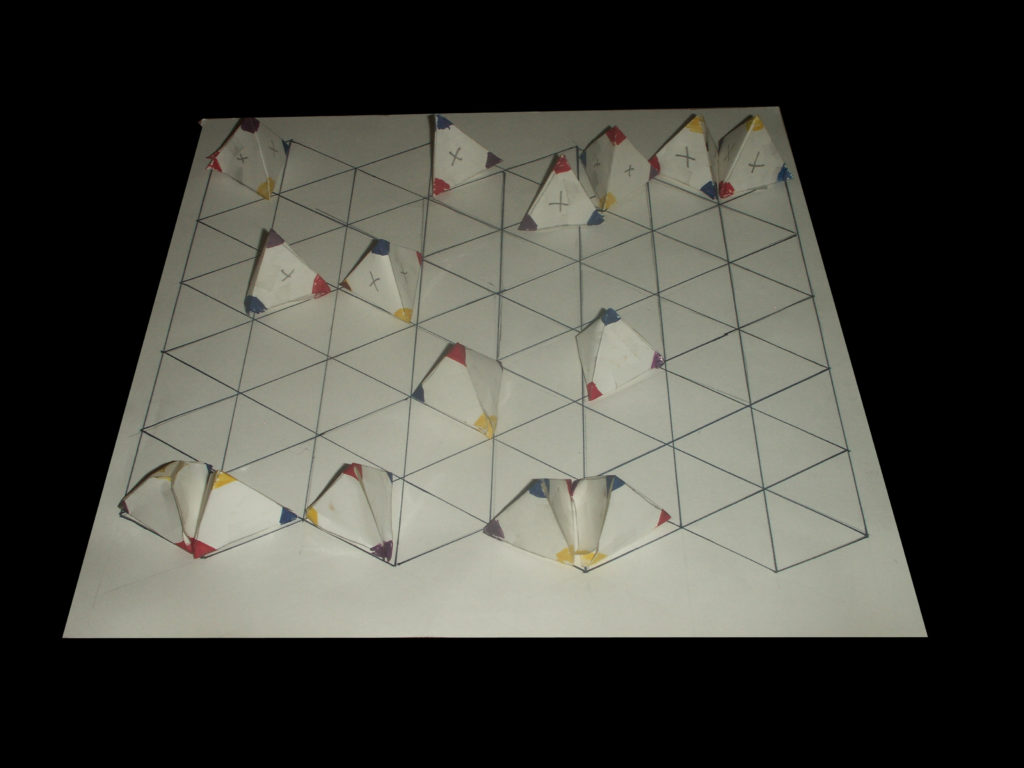
The original board. Triangular spaces were the right instinct — but the multicolored piece tips created too much ambiguity. Players couldn't reliably predict which color would face up after a flip, making strategy feel like guesswork.
Final Design
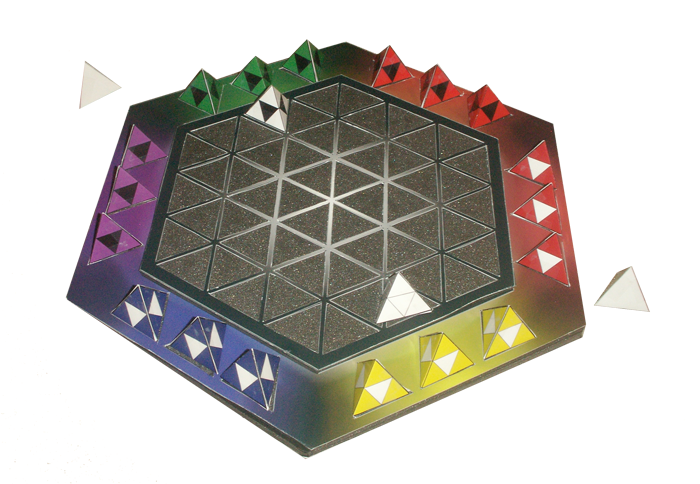 Final gameboard
 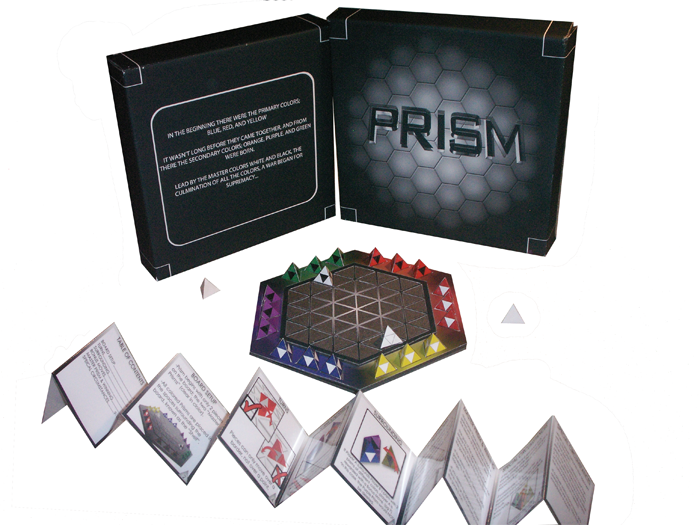 Final product layout
 Solid-colored pieces, a refined board shape, and the Shelf deployment system transformed Prism from a broken prototype into something that actually plays well.
What I Learned
Prism is where my design instincts developed. Iterating through broken versions to find the one that actually worked taught me more about game balance than any class could.
The move from unpredictable color mechanics to deterministic flipping was the turning point — and a lesson I carry into every game I design now.
Credits
| Design & Art | Michael Paynter |
| Type | Student Project · Board Game |
| Tools | Photoshop |